Visual storytelling becomes stronger when your writing starts from images, not just words.
I recently came across a reel that proposed an interesting idea:
that theatre comes from ritual, film from photography, and television from radio. See inspiration here.
I found the perspective compelling, and it made me rethink how stories begin, especially in film.
This article is inspired by that idea and explores it further through visual storytelling: starting from images and building them into words.
Visual storytelling: it begins with the image
There’s a simple idea that explains a lot about how different storytelling mediums work:
🎭 Theatre comes from religion.
🎬 Film comes from photography.
📺 Television comes from sound.
Each one shapes how stories are told and more importantly, how they are experienced.
For film, everything begins with the image.
Film starts with an image
Before dialogue, before structure, before even plot, film begins with something visual.
A moment.
A composition.
A feeling captured in an image.
Like a photograph.
Think about some of the most memorable films, you don’t remember them first as lines of dialogue, but as images:
a character alone in a vast space,
a face in close-up,
a specific light, a color, a gesture.
These are not just scenes.
They are frames.
And strong visual storytelling often begins with one.
Why thinking in images changes everything
When you start from dialogue, you tend to write conversations.
When you start from structure, you tend to build mechanics.
But when you start from an image, you start from meaning.
That’s the core of visual storytelling.
An image already contains:
✅ emotion
✅ tension
✅ subtext
It doesn’t explain, it shows.
And that’s exactly what film does best.
Television and sound: a different logic
Television comes from radio, which is why sound carries the story.
People didn’t always sit down and watch TV fully.
They moved around, did other things, left it playing in the background.
Because of that, sound became essential.
Dialogue carries information.
Voices keep attention.
The story must be understandable even without constant visual focus.
Film, on the other hand, asks for attention.
It rewards looking and that’s where visual storytelling in film becomes essential.
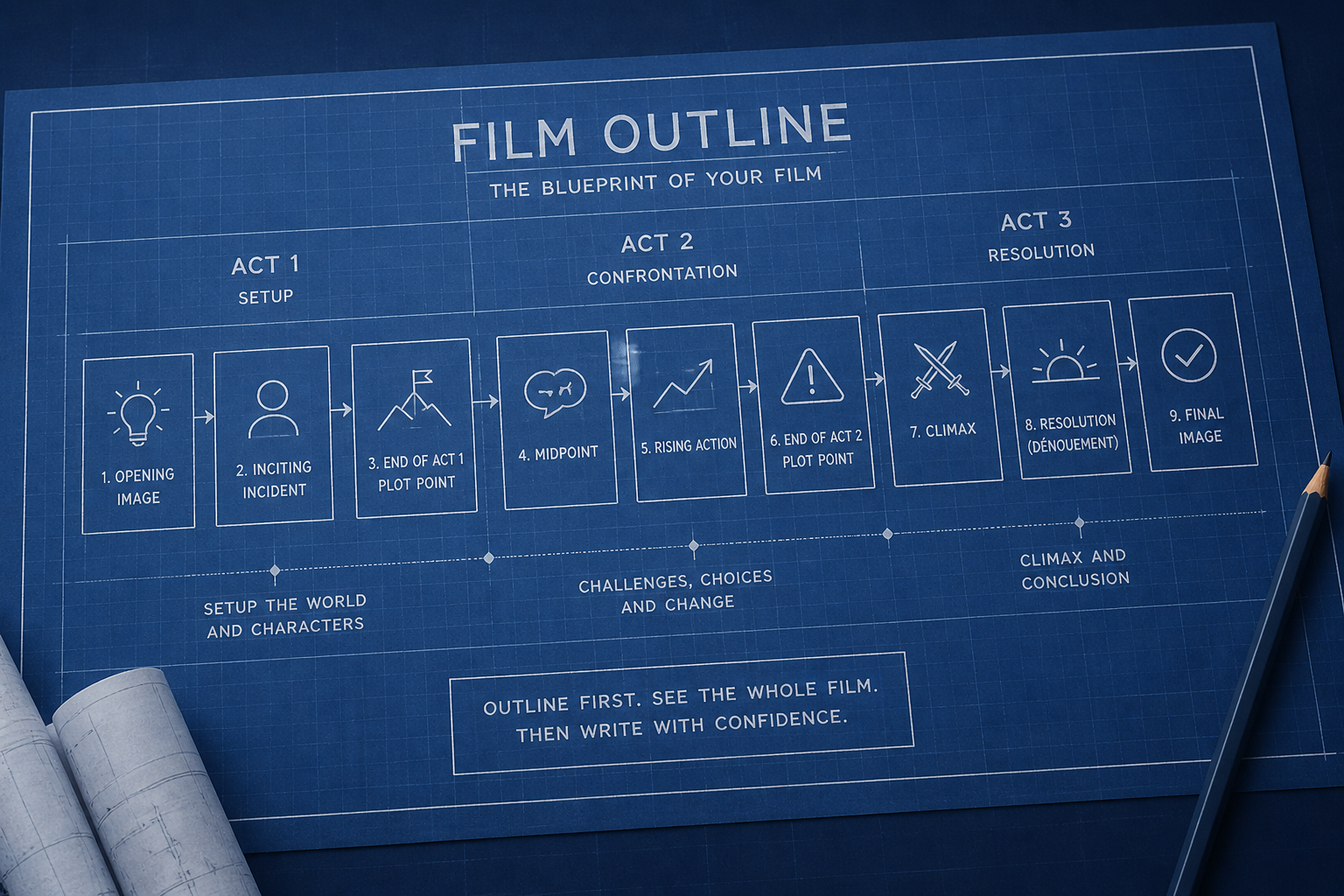
From image to outline
So what happens if you start your film not with a plot, but with an image?
Instead of asking:
“What happens?”
You ask:
“What do I see?”
That image becomes your first card.
Your first moment.
From there, you start building:
what led to this image,
what follows,
how it transforms.
Your outline becomes a sequence of visual moments, not just events, a foundation for strong visual storytelling.
Visual storytelling tool
FilmPlan, desktop app, is a film outline tool designed around this exact idea: starting from images and building your story visually.
Instead of working in long documents, you create your film using cards: one scene, one moment at a time. You can organize your structure, move scenes freely, and see how your story evolves from beginning to end.
It’s a more intuitive way to outline — especially when your ideas begin as images, not words.
👉 Download FilmPlan and start outlining your film visually, see Features.
You can also follow us on Instagram the.film.plan for visual examples of film outlines and how stories come together through images.
If you want to understand how to turn these visual moments into a structured story, start here: